
VERS UN VIRAGE
Dialog with Elisabeth Lenk. An exhibited text. Janus 2026, Tokyo

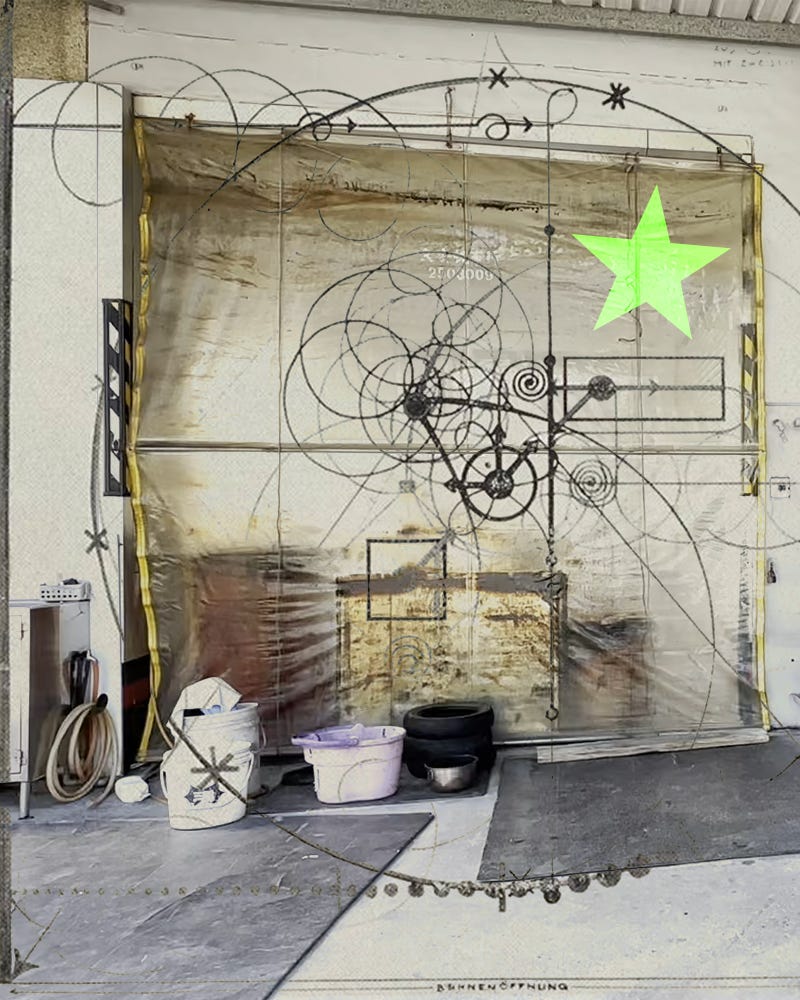
The role phantasy plays in everyday life varies from person to person and is best known by the conscious daydreamer. Trying out scenarios reachable in the person’s circumstances may be called strategic imagination which, together with memory capacities, gives humans an advantage to animals. As soon as imagination leaves the concrete chambers of reason, it becomes purely “phantastic”, so to say. Varying in pride, lust, gluttony, greed, sloth, wrath and envy, in grandeur, ambition, perversion, violence, ambivalence or deliberate unpleasantness, she turns into an ageless form of play; evoking autoeroticism, a tickling stimulus or an earnest call to arms in the name of creation.
Elisabeth Lenk: Phantasy is curbed life. She is the substance of thought, circumcised of ‘practical sense’, mutilated and tolerated by society only in her functions of decoration and service. Where she gets out of hand, she is numbed with psychotropics. If women do not eradicate the great housewife within themselves, the nascent, still very small freedom will soon be stifled again by homespun self-imposed constraints.
Shima: The lady formulating these lines in 1976 was the German literary scholar and sociologist Elisabeth Lenk. An excellent student of Theodor W. Adorno and at the arrowhead of European intelligentia alongside Silvia Bovenschen and Rita Bischof, Lenk lived and expressed thinking in her generation parallel to Yayoi Kusama, Rebecca Horn, Yoko Ono, Rei Kawakubo, Marina Abramovich, Ana Mendieta, Hanne Dabroven and other distinct female figures. During their lifetime these women had carved out a place for their phantasies, their truths. They found this ever-praised Room of One’s Own Virginia Woolf had yearned for since the 1920s. Lenk’s collection of essays titled Critical Phantasy is the basis of our (phantastic) dialogue.
EL: In phantasy, opposites are still together; of her feeds the sense of nuance, of contrast, a protest against divisions, against the regulation of thought.
S: Phantasy is bound to fetishes. Fetishes stem from phantasies of the untouchable, desirable, the fatamorganic, therefore the holy.
EL: The aesthetic question cannot be separated from the erotic question. And yet I want to keep them apart. The erotic is as capricious as happiness. Often, when the euphoria is at its greatest, one crashes. In the erotic, one is completely dependent on momentary moods. It goes up and down at breakneck speed, like a roller coaster, and finally arrives back at the starting point, empty and exhausted. Perhaps this is also because the feeling moves so infinitely slowly. But precisely because there are these crashes, these endlessly long, dreary days, I want to keep the aesthetic and the erotic separate. The aesthetic encompasses all moments, even the weak, dull, boring ones, while the erotic always rushes toward events. The aesthetic can even revel in boredom. It does not dispel it—that would simply be distraction—but rather extends it; it is the power to increase boredom to the point of unbearability.
S: Furious cries of woe from Nina Simone, Kathy Acker, Valerie Jean Solanas, Valie Export, Vivienne Westwood, Nina Hagen,…… needed to break free, free the sexual organs, the nipple, the Varicose vein, free the voice, rip the corset, escape the bondage. In the age of KALI, they needed to swing from pole to pole, to turn into a somersaulting wrecking ball, unleashing the infamous female rage, unleashing Audre Lorde: “I am not free while any woman is unfree, even when her shackles are very different from my own.” Past the burning anger of Suffragettes, past Guerilla Girls, past feminist tsunamis, past COMME DES GARCONS - between ashes, rubbles and ruins echoing screams that had been dimmed long enough. New territories were torn open for new pendula to search for new motions, indulge in new (dis-)harmonies.
EL: The “feminine” has been set in motion. It can no longer be reduced to a set of attributes, or even to an unchanging character structure. And so female aesthetics cannot simply be the return of “typically” feminine elements in art. But when women begin to conquer the aesthetic dimension, when the beautiful silent image dissolves, then the false mystery must necessarily be demystified. It may be that something about beauty will still remain enigmatic. But the mystery does not [only] lie where men have long suspected it to be: in the fetishistic contemplation of appearance, in contemplative aesthetics.
S: Artists flesh out phantasies by applying (aesthetic) principles to media. VERS UN VIRAGE shows positions of four female artists, yet, I suggest the term feminin to be understood in a way Lenk describes it.
EL: In her new relationship with herself, she is many, or rather: she momentarily dissolves into pure movement. Femininity is then as distant from her as masculinity and the whole world riddled with characteristics. This is a movement that was long a dream, but which, when it awakens to consciousness, multiplies: an action from the outside in and, in this respect, a reversed, mirror-image action: aesthetic action.

Each artist in VERS UN VIRAGE deals with the components erotic, aesthetic and phantasy on individual terms.
Abi Perkins. The etched figures take the empty space with their silhouette, stark contrasts give a sense of urgency, of drama. Exteriors influencing the interior, climaxing together at their peaks, in this moment the image is taken. Different from EL’s analysis of the erotic, the crash stays out. The peak immortalized in an aesthetic monument, etched in stone and time, symbolic. A premeditated phantasy is fleshed out and perfected on spot, every inch of body, exterior and each gaze sophisticated. This proud sweet spot prolonged by the technique, simultaneously creating a superficial and psychological phantasy: Against the ominous vanity of the white void Perkins erects iconographies.
Alice Kister. Soyez réalistes, demandez l’impossible! Her images stretch out a gentle hand to enter an abundant mise-en-scène animated by eccentric characters. By transforming all possible elements, the set, costumes, lighting, props and make-up, immersion becomes inevitable. Eroticism is tangible in the montage, yet it is a playful, moving spirit rather than a static, Newton-esque capturing of exposed, sexually arousing bodies. Genderfluid eroticism melting into the phantasies and narratives, the images not forcefully evoking these sensations in the viewer. Phantasies are staged, built up, existing intensely for all inhabitants – suddenly evaporating, leaving an afterglow – like a dream, a decadent night in the Golden 20s, a magic trick?
Polina Ganz. Poetic gestures, soft lights and textures characterize these intimate portraits. The viewer becoming a voyeur of quiet scenes, shy and distant faces with steely gazes. A sense of purity mingling with minimalistic alterations creates a subtle interplay of reality and phantasy. The characters live inside phantasies, not accessible to the viewer. We are close, almost part of the composition, yet unknown yearnings draw their attention into the invisible.
Rosa von Lieven. The camera searching for movie scenes, self-created expressive characters, that unexpected special guest at the bar, a sassy comment by the lady between the two gentlemen, flirty laughter, smoke rises from Vouges, the perfect song in the Jukebox – there! The phantastic moment! Each deliberately plays their part, von Lieven taking part in the scene as well, capturing what’s magic in the moment and by doing so, enriches the phantasy of the viewer with possibilities, love, statements, warm memories filled with euphoric nostalgia. A decadence so self-aware and out there, it becomes authenticity.
Tokyo, 2026